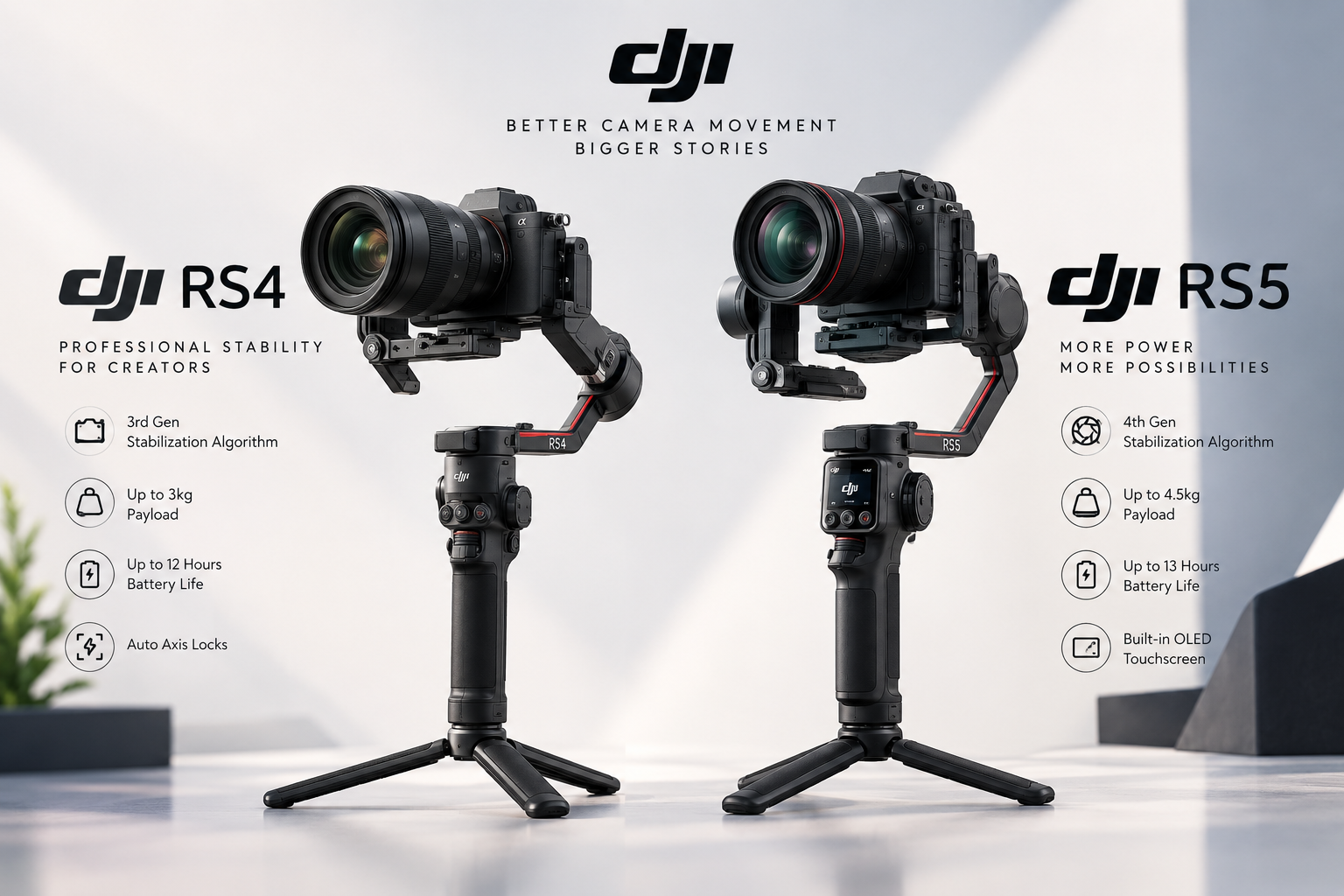
DJI's Ronin gimbals have become the default choice for solo filmmakers and content creators, and right now two models sit at the centre of that decision: the newer DJI RS 5 and the still-excellent DJI RS 4. They look similar, they weigh about the same, and they carry the same size cameras. So what actually changed, and is it worth paying more for the RS 5? This guide breaks it down.
The short answer
- Buy the DJI RS 5 if you want the latest stabilization, one-hour charging, longer battery life and the newest tracking system - and you plan to keep the gimbal for years.
- Buy the DJI RS 4 if you want to save money, already shoot mostly hand-framed shots, and are happy with a proven gimbal that still performs brilliantly.
Neither is a bad choice. The RS 5 is the better tool; the RS 4 is the better value.
Specs side by side
- Tested payload: RS 5 - 3 kg (6.6 lb) | RS 4 - 3 kg (6.6 lb)
- Handheld weight (with grip & plates): RS 5 - about 1.46 kg | RS 4 - about 1.5 kg
- Stabilization: RS 5 - 5th-gen RS algorithm, ~50% more peak torque | RS 4 - 4th-gen RS algorithm
- Battery life: RS 5 - around 14 hours | RS 4 - around 12 hours
- Full charge time: RS 5 - about 1 hour | RS 4 - about 2.5 hours
- Screen: RS 5 - full-color touchscreen | RS 4 - 1.8-inch full-color touchscreen
- Vertical shooting: RS 5 - 3rd-gen built-in switch | RS 4 - 2nd-gen built-in switch
- Axis locks: RS 5 - 2nd-gen automated | RS 4 - automated axis locks
- Tracking: RS 5 - RS Enhanced Intelligent Tracking Module | RS 4 - original Intelligent Tracking Module (add-on)
Where the RS 5 pulls ahead
5th-gen stabilization with more torque
The RS 5 uses DJI's newest stabilization algorithm and roughly 50% more peak motor torque than the RS 4. In real use that shows up when you are moving fast, changing angles quickly, or shooting in wind - the horizon stays locked and the motors recover faster after a sudden jolt. Heavier lens-and-body combinations also feel more secure on the RS 5.
One-hour fast charging
This is the upgrade you feel every single shoot day. The RS 5 charges fully in about an hour, versus roughly 2.5 hours on the RS 4. A quick top-up during a lunch break is enough to finish a long day, so you are far less likely to get caught with a flat gimbal.
Longer battery life
The RS 5 has a larger internal battery and lasts around 14 hours per charge, compared with about 12 hours on the RS 4. Combined with the faster charging, the RS 5 simply gets in your way less.
Enhanced Intelligent Tracking
Both gimbals can track a subject, but the RS 5 works with the new RS Enhanced Intelligent Tracking Module. You frame the subject on the gimbal's own touchscreen, it follows people, pets, vehicles and objects at up to around 10 metres, re-acquires a subject that briefly leaves the frame, and supports gesture control so you can start and stop tracking from in front of the camera. The RS 4's original tracking module is capable but less refined and needs more setup.
Small handling refinements
The RS 5 adds low-friction fine-tuning knobs for smoother balancing, a Z-axis indicator to catch front-to-back imbalance, and faster native vertical switching. None of these are dramatic on their own, but together they shave time off every setup.
Where the RS 4 still makes sense
- Price. The RS 4 usually costs noticeably less, and often comes with attractive bundle deals.
- Proven performance. The 4th-gen stabilization is still very good - most viewers will never see the difference in normal footage.
- Same cameras, same weight. If you shoot a mirrorless body with a mid-range zoom and frame your own shots, the RS 4 does everything you need.
- Mature accessory ecosystem. Grips, focus motors, briefcase handles and plates are widely available and often discounted.
Which one is right for you?
Choose the DJI RS 5 if...
- You shoot solo and rely on subject tracking.
- You film long days - weddings, events, corporate - and value fast charging and battery life.
- You want the most future-proof option and plan to keep it for several years.
- You frequently switch between horizontal and vertical shooting.
Choose the DJI RS 4 if...
- Budget is the priority and you want the most gimbal for your money.
- You mostly operate the camera by hand and rarely use tracking.
- You are upgrading from a phone gimbal or an older RS 2 / RS 3 and just need a reliable full-size stabilizer.
- You can charge overnight and do not need a one-hour top-up.
Final verdict
The DJI RS 5 is the better gimbal in almost every measurable way - stabilization, charging, battery, tracking and handling - and it is the one to buy if your work depends on the gimbal keeping up with you. The DJI RS 4 remains a superb stabilizer and the smart pick for creators who want proven performance without paying for the newest features. Match the gimbal to how you actually shoot, and either one will serve you well.
Check current pricing, stock and bundle options for the DJI RS 5 and DJI RS 4 on Arfa Electronics, or contact our team for a live quote.